GymDroid
Can You Build Muscle at Home? Yes, With One Rule
Yes, you can build muscle at home, as long as your workouts get harder week after week.
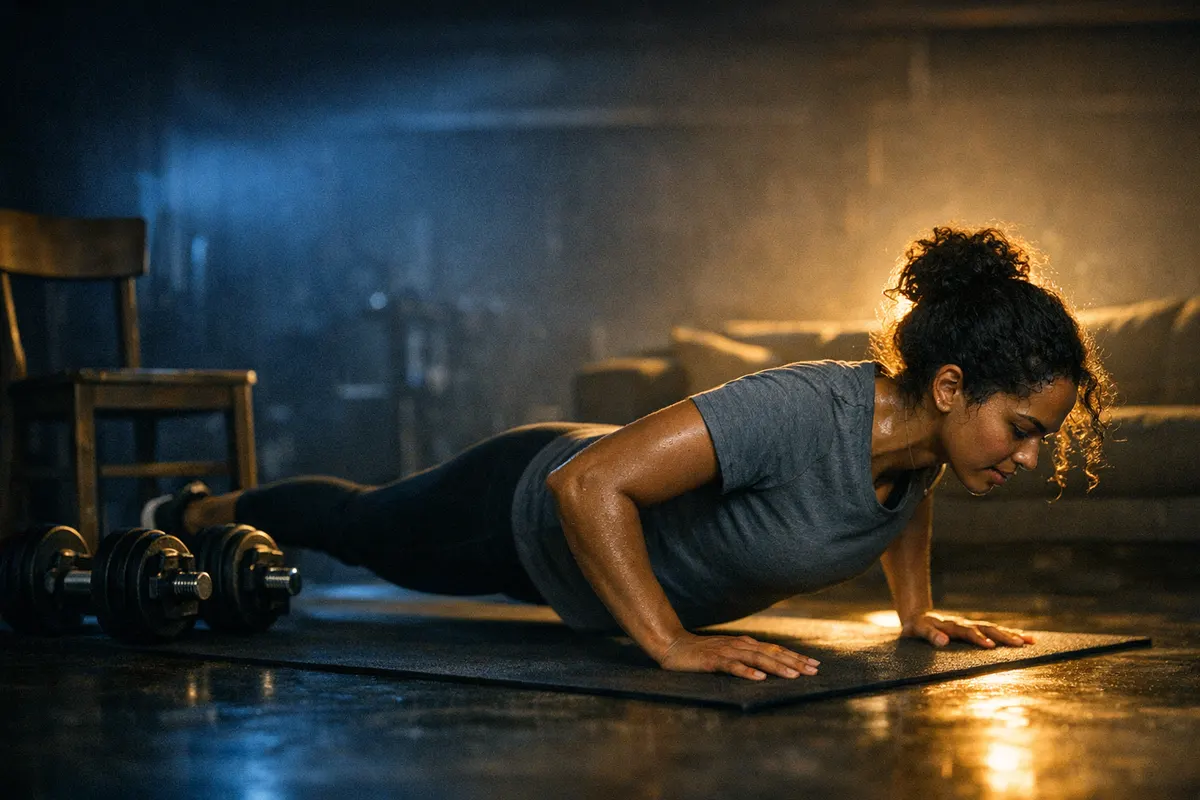
Can you build muscle at home? Yes. Your muscles do not know if they are in a gym or in your living room. They only feel how hard the work is.
The one rule is progressive overload. Each week, the work has to get a little harder. Below you learn how to do that with bodyweight first, when to add dumbbells, and how to plan a full home week.
Why you can build muscle at home
Muscle grows when you give it a hard enough reason to grow. Three things create that reason:
- Effort. Sets that end close to failure, with 0 to 3 reps left in the tank.
- Volume. About 10 to 20 hard sets per muscle per week.
- Progression. More reps, more load or a harder version over time.
None of these need a gym. Studies comparing light and heavy loads found similar muscle growth, as long as people trained close to failure. A push up done to 2 reps short of failure is a real muscle building set.
So the question is not “home or gym”. It is “do my sets get harder, and do I do enough of them?” For the weekly numbers, read how many sets and reps build muscle.
Where home training has limits
Bodyweight has one weak spot. Once you can do 30 or more reps of a move, the set turns into endurance work, and it takes a long time to reach failure.
Legs hit this wall first. Your legs carry your body all day, so a bodyweight squat gets easy fast. Pull muscles are the other gap: without a bar or dumbbells, the back gets little work. Both problems have simple fixes, shown below.
How to make bodyweight exercises harder
You cannot add a plate to a push up. But you can make it harder in other ways. Use them in this order.
- Add reps. Go from 8 to 15 good reps.
- Slow down. Take 3 seconds to lower, pause 1 second at the bottom.
- Shorten rest. Only for circuits. For strength sets, keep 1 to 2 minutes.
- Use one leg or one arm. A split squat loads each leg with far more of your body weight than a squat.
- Change the angle. Feet on a chair makes a push up harder.
- Add load. A backpack with books or water bottles, then dumbbells.
Bodyweight progressions that build muscle
Each row goes from easier to harder. Move to the next step once you can do 3 sets of 15 clean reps.
| Muscle | Easier | Middle | Harder |
|---|---|---|---|
| Chest, triceps | Incline push up on a table | Push up | Feet raised push up |
| Legs, glutes | Bodyweight squat | Reverse lunge | Bulgarian split squat |
| Glutes, hamstrings | Glute bridge | Single leg bridge | Single leg hip thrust on a sofa |
| Back, biceps | Towel row on a door | Table row | Pull up on a door frame bar |
| Core | Plank | Long lever plank | Hollow body hold |
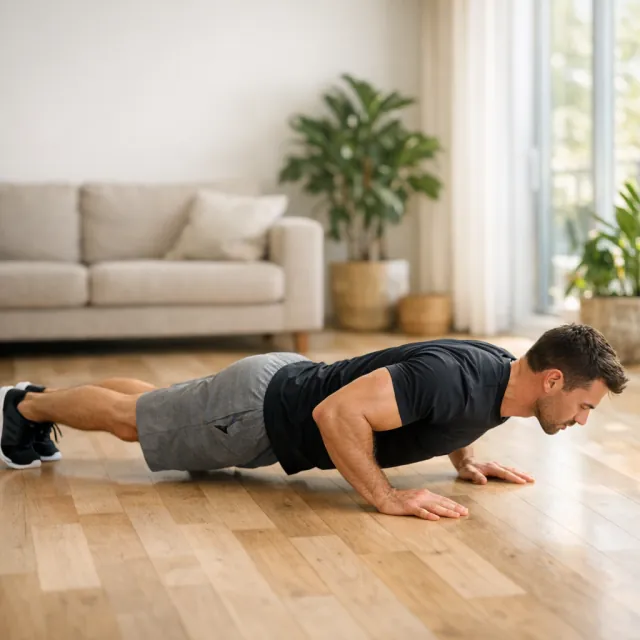
The push up is your main upper body builder at home. The Bulgarian split squat is the best leg move with no weights, because one leg does the work. The glute bridge trains the glutes and is easy to load with a backpack on your hips.
Bodyweight workout for muscle mass: a sample session
This session trains the whole body. Do it 3 times a week with a rest day in between. Pick the step of each move that lets you do the reps with 1 to 3 reps left.
| Exercise | Sets | Reps | Rest |
|---|---|---|---|
| Push up (your step) | 3 | 8 to 15 | 90 s |
| Split squat or reverse lunge | 3 | 8 to 15 per leg | 90 s |
| Table row or towel row | 3 | 8 to 15 | 90 s |
| Single leg glute bridge | 3 | 10 to 15 per leg | 60 s |
| Plank | 3 | 30 to 60 s | 60 s |
That is 15 sets in about 35 minutes. Over 3 days, each muscle gets 9 to 12 hard sets a week. That is enough for steady growth in your first months.
New to training? Start with the bodyweight full body workout. It is a 25 minute circuit, and you can see every move from every angle before you try it.
When to add dumbbells
Bodyweight takes most beginners a long way. Add dumbbells when one of these happens:
- You do 20 or more reps of your hardest leg move and it still feels easy.
- You have no good way to train your back.
- Progress has stalled for 3 to 4 weeks, even with good sleep and food.
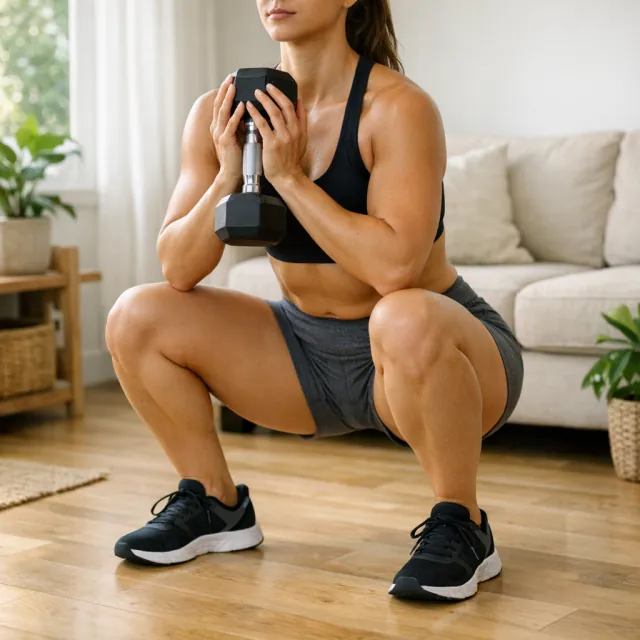
A pair of adjustable dumbbells is the best single buy for home training. They let you add 1 to 2 kg at a time, which is the easiest kind of progress. Add a bench or a sturdy chair, and you can train every major muscle.
With dumbbells, use double progression:
- Pick a weight you can lift for 8 reps with 2 reps left.
- Add reps each session until all sets reach 12.
- Add 1 to 2 kg per dumbbell and go back to 8 reps.
The dumbbell full body workout is a good first session. When you want a full program, the Dumbbell Home Essentials plan gives you 3 days a week for 9 weeks, with rows, split squats, Romanian deadlifts and presses.
Build muscle at home without equipment: a 4 week progression
Here is how one month of progress can look on push ups, for someone who starts with 8 reps.
- Week 1: 3 sets of 8, 8, 7.
- Week 2: 3 sets of 10, 9, 9.
- Week 3: 3 sets of 12, 11, 10, with a 3 second lowering.
- Week 4: 3 sets of 14, 13, 12, with a 3 second lowering.
Once you reach 3 sets of 15, move to feet raised push ups and start again at the bottom. The same pattern works for every move in the table.
The key is to write it down. If you do not know what you did last week, you cannot beat it. Log your reps in GymDroid after each set, and the next session shows you the number to beat.
Food and sleep still decide the result
Training gives the signal. Food and sleep build the muscle.
- Protein: about 1.6 to 2.2 g per kg of body weight a day, spread over 3 to 5 meals. More in how much protein to build muscle.
- Calories: eat a little more than you burn, about 200 to 300 kcal a day, if your main goal is muscle.
- Sleep: 7 to 9 hours a night. Recovery is slower without it.
Home training also saves travel time. Use that time to sleep a bit more or cook a proper meal.
Common mistakes in home workouts
- Doing the same workout for months. If nothing gets harder, nothing changes.
- Stopping far from failure. Easy sets of 10 when you could do 25 build little muscle.
- Only cardio style circuits. Fast circuits with short rest are good for fitness, less so for muscle.
- Skipping the back. Push ups without rows can pull your shoulders forward over time. Always pair them.
- Bad form to hit a number. Half reps do not count. Slow down and use the full range.
If you have joint pain, a past injury or are pregnant, ask your doctor or a physiotherapist which moves are right for you before you start.
Put it together
You can build muscle at home. Train 3 times a week, take your sets close to failure, and make one thing harder every week. Start with bodyweight, add dumbbells when your legs outgrow it, and eat enough protein.
Pick one of the home workouts, log every set, and check your numbers again in 8 weeks. You will see the progress in your log before you see it in the mirror.